The Random Label Is Not a Promise
Understand what “random” means in an online casino game, distinguish independent rounds from shared pools, and avoid treating past results as a forecast.

What does “random” mean in an online casino game, and can it tell you what comes next? The random label describes how a game presents outcome selection, but its meaning depends on the rules: it does not, by itself, explain the possible results, their likelihood or how rounds relate.
What selection means
A game’s rules may explain that an outcome is selected through a random process. That description is narrower than it can sound. It does not automatically mean every result is equally likely, that every possible result has been listed on screen, or that a player can predict the next one.
Consider the difference between a menu and a recipe. A list of outcomes tells you what might appear; the selection rules explain how the game chooses among them. The word “random” alone does not supply either detail. Look for the game’s rules or information panel, and distinguish its actual explanation from short promotional wording.
Rounds and shared pools
Independence is a specific relationship between rounds: an earlier result does not change the chances of a later one. Some games may describe rounds as independently selected; other formats can involve a shared pool or a state that changes as play continues. The label “random” does not tell you which arrangement applies.
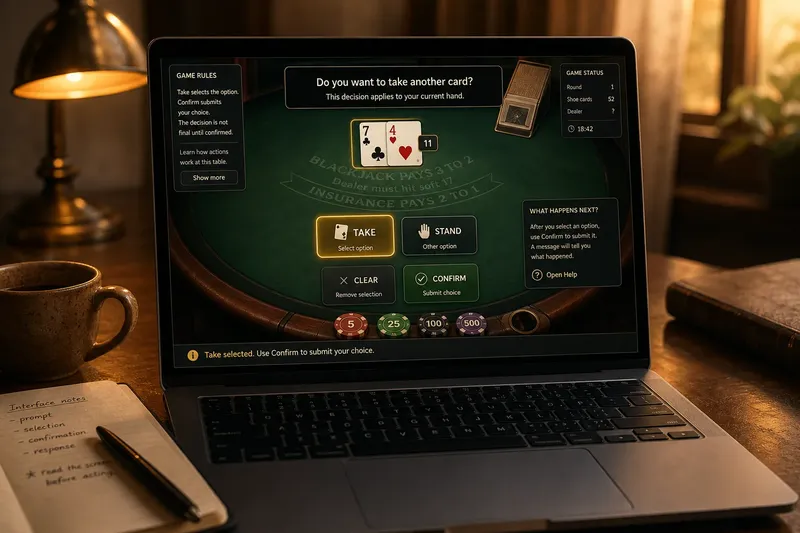
Say you are reading the rules for a fictional card game. They state that each hand is dealt independently from a newly shuffled deck. You note that the previous hands do not make any particular card due, then decide whether you understand and accept that rule. If instead the rules say cards are drawn from one shared deck without being replaced, you follow that description: earlier draws affect what remains, so the independent-round assumption would not fit.
It is not worth the effort to infer the selection method from a reel’s animation, a wheel’s pauses or a card’s reveal. Those details tell you how the result is displayed, not whether the rules describe independent rounds or a shared pool.
Streaks and expectations
Random selection does not mean that results must alternate or balance out over a short run. Repeats and clusters can occur; seeing one does not, on its own, show that a different result is due. Equally, a streak is not evidence that it will continue. The useful question is not what a recent sequence seems to promise, but what the game’s stated rules say about the next selection.
Keep three claims separate: outcomes are selected randomly; each outcome has equal likelihood; and each round is independent. A game might make one claim without making the others. If its explanation does not address a question you care about, do not fill the gap with a hunch.
What does random mean?
Does random mean equal odds?
No. The word alone does not say that each possible outcome has equal likelihood. Look for a separate explanation of the outcome set and likelihoods, if the game provides one.
Can random results repeat?
Yes. Random selection does not rule out repeats or clusters. Their appearance is not, by itself, a forecast of the next result.
Are all rounds independent?
No general label answers that for every game format. Check whether the rules describe independent rounds or explain that outcomes depend on a shared pool or earlier events.
What if the rules are unclear?
Do not assume odds or independence that the rules do not explain. Ask the operator for clarification, and choose not to play if you still cannot understand the terms.
Reading the rules
- Selection method: If the rules explain how an outcome is selected, use that explanation; if they only say “random”, seek fuller information rather than guessing the method.
- Round relationship: If the rules say rounds are independent, treat previous results as irrelevant to the next selection; if they describe a shared pool or dependencies, follow that account instead.
- Possible outcomes: If the game lists the results that can appear, use that list to understand the outcome set; if it does not, do not assume the random label supplies one.
- Likelihoods: If the rules separately state that outcomes are equally likely, read that as an additional claim; if they do not, do not infer equal odds from “random”.
- Promotional claims: If copy says a result is “due” or that a streak is building, look for an explanation in the rules; if none appears, treat the wording as persuasion rather than a prediction.
- Your understanding: If you can explain how the rules connect one result to another, decide whether you are comfortable proceeding; if you cannot, pause to ask for clarification or leave the game.
For the random label on an online casino game, the practical distinction is between a claim about selection and the specific rules that define outcomes and relationships between rounds. Read those rules before treating results as equally likely, independent or predictive; if the explanation remains unclear, stepping away is a sound decision.